How much of a condo's price discount survives HOA costs?
An extra $600 a month requires about $99,000 less in purchase price under one transparent scenario. Compare net HOA costs, financing and purchase cash before deciding how much of a condo discount remains.
Housing Alpha Research · Published 2026-10-04
4 minute read · Editorial independence
A condo that costs $150,000 less can still leave only about $308 more in your monthly budget. In our fictional comparison, the smaller mortgage and tax allowance save $908 a month, but $600 of additional recurring ownership costs absorbs most of that saving.
The useful number is the net cost difference after accounting for what the HOA covers. Under the central assumptions below, every extra $600 a month requires approximately $99,066 less in purchase price to reach the same monthly outlay. This is a budgeting calculation, not a condo valuation or a claim about typical Bay Area dues.
First, compare the same responsibilities
An HOA fee is not simply an extra mortgage payment. It may fund shared maintenance, insurance and reserves that an owner would otherwise pay separately. Fannie Mae explains those association responsibilities and possible special assessments.
For each actual home, add regular dues, owner-paid insurance, a reserve for your own maintenance responsibilities and separately paid services. Subtract the alternative home's equivalent expenses. Keep mortgage payments and property tax separate for the next calculation.
Count each responsibility once. Do not add a detached-house roof budget on top of dues already funding the condo roof. Conversely, dues do not establish that reserves are adequate. Review the master policy and an address-specific unit-owner quote together; California's insurance guide explains the division of coverage. An insurance-price difference is not proof of equivalent protection.
What price reduction offsets an extra monthly bill?
Assume 20% down, a 30-year fixed loan, $0 mortgage insurance and annual property tax equal to 1.2% of the purchase price. Test interest rates of 5.5%, 6.5% and 7.5%. These are deliberately chosen scenarios, not current quotes or recommended tax allowances. Both homes receive the same rate within each comparison.
At 6.5%, a $100,000 lower price saves approximately $506 in monthly principal and interest, plus $100 in the tax allowance. Divide the net extra monthly cost by that per-dollar saving to find the required price reduction. Hold the other dollar costs fixed while doing this calculation.
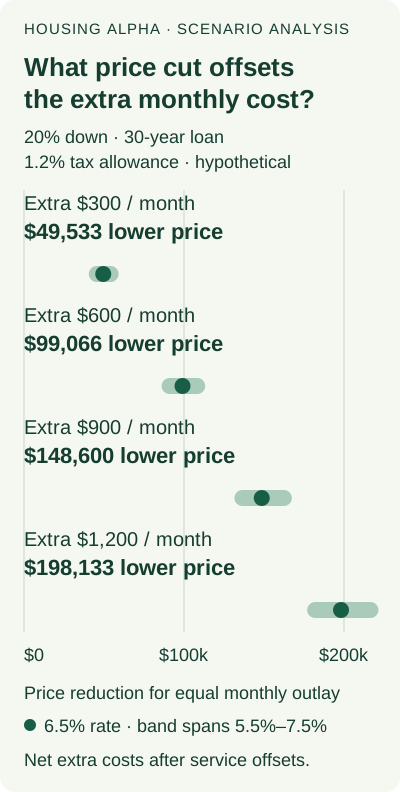
For $600 extra each month, the required reduction is approximately $108,258 at 5.5%, $99,066 at 6.5%, or $90,996 at 7.5%. Higher rates make each dollar of avoided borrowing save more monthly cash; they also make both loans more expensive. This is not an argument for a higher rate.
Download all 12 calculated scenarios. The calculation measures monthly cash allocation, including principal repayment. It does not equate lifetime ownership costs, equity accumulation or resale value.
A $150,000 discount: how much survives?
Consider two entirely fictional homes that a household might compare. Neither is a listing, a market average or evidence that the locations, space and condition are equivalent.
- House: $1,200,000 price, $0 HOA dues, $200 monthly insurance and $500 monthly owner-maintenance allocation.
- Condo: $1,050,000 price, $900 HOA dues, $150 monthly unit-owner insurance and $250 monthly owner-maintenance allocation.
Assume the condo's dues fund the shared responsibilities excluded from its smaller personal maintenance allocation. Assume other omitted recurring costs are equal. The condo's net extra cost is $900 − $250 less personal upkeep − $50 less insurance = $600 a month. These invented allowances require replacement with actual evidence.
At 6.5%, the modeled totals are $7,968 for the house and $7,659 for the condo. The condo saves $308 a month, calculated before rounding each total. Its lower loan repays about $108 less principal in the first month, so the difference in first-month costs excluding principal is only $200. The CFPB explains why principal and interest alone are not a complete monthly budget.
Cash and assessments can change the decision
With the same 20% down payment and an illustrative 2% buying-cost allowance, the condo initially needs $231,000 versus $264,000: $33,000 less. A separate $20,000 assessment payable by the buyer at purchase would reduce that advantage to $13,000. Do not also count that bill as a recurring charge.
Alternatively, a $250 monthly assessment lasting 24 months would reduce the condo's monthly advantage to approximately $58 during that period. That is a separate scenario. Confirm who pays, the due dates and the work involved using the association documents identified by California DRE.
The 1.2% tax allowance is not a parcel estimate. Check purchase-related reassessment rather than copying the seller's bill; California BOE explains supplemental billing. Our purchase-cash totals exclude emergency reserves, moving and unentered repairs. They are not the lender's cash-to-close calculation.
Apply the comparison to your own options
Start with the ownership-cost calculator. Enter each home's price, financing and separately payable costs. Convert a monthly owner-maintenance allowance to the calculator's annual percentage as monthly allowance × 1,200 ÷ purchase price. Only enter responsibilities outside dues.
For two actual candidates, the home comparison worksheet also separates recurring assessments from upfront costs. Use our HOA document guide to replace assumptions. Different loan offers, future dues, insurance, repairs and resale outcomes can change the result. Keep the question concrete: how much monthly breathing room remains, and which unverified expense could erase it?
Sources
Cite this article
Housing Alpha Research. “How much of a condo's price discount survives HOA costs?.” Bay Area Housing Alpha. Published . https://bayareahousingalpha.com/articles/bay-area-condo-discount-ownership-costs
Found an error or a source we should review? Send a correction to research@bayareahousingalpha.com, with this article’s URL and the supporting evidence.