Which home costs less? A worked Bay Area buyer comparison
Two fictional condos show how a $100,000 price difference becomes a $69 monthly tradeoff after HOA charges, repairs and financing. Reproduce the calculation, test the uncertain inputs and save your own comparison.
Housing Alpha Research · Published 2026-09-25
6 minute read · Editorial independence
Imagine two condos that could both fit your household. Home A costs $100,000 less to buy. Does that make it easier to afford?
In this fictional example, Home A needs about $69 more each month and only $2,000 less upfront once its HOA charges and immediate repairs are included. Comparing the purchase prices alone would miss the tradeoff.
The homes, prices, financing and other amounts below are entirely hypothetical. They are not listings, Bay Area averages, quotes or a recommendation to choose either home. The calculation shows how to use the home comparison worksheet with your own options.
Start with the same financing and a clear question
Assume both homes are condos with three bedrooms, two bathrooms and 1,350 interior square feet. Their layouts, locations and condition would still need separate review; matching those three numbers does not make real homes equivalent.
Use 20% down, a 30-year fixed mortgage at 6.5%, a 2% buying-cost allowance and $0 monthly mortgage insurance for both. The interest rate and allowances are illustrative. Replace them with the terms available for each actual property and loan.
For both homes, assume annual property tax equal to 1.2% of the purchase price, unit-owner insurance of $150 a month, and a personal maintenance reserve equal to 0.3% of the price annually. That reserve is an invented allowance for future unit-owner responsibilities beyond the separately entered immediate repairs. It is not a recommended percentage or a claim that the association has adequately funded shared work.
Now add the differences:
- Home A: $1,100,000 purchase price; $1,000 monthly HOA dues; a $250 monthly special assessment assumed to last another 24 months; and $25,000 for immediate repairs.
- Home B: $1,200,000 purchase price; $550 monthly HOA dues; $0 current special assessment assumed; and $5,000 for immediate repairs.
Assume comparable services are included in the two HOA fees solely to make this calculation readable. With real homes, check the budgets and responsibilities before treating the fees as comparable. Fannie Mae describes why dues, reserves and special assessments all matter.
The monthly result: the lower price does not win this comparison
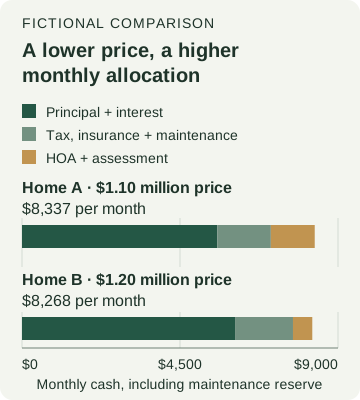
Home A: $8,337 a month. That comprises $5,562 principal and interest, $1,100 property tax, $150 insurance, $275 maintenance reserve, $1,000 HOA dues and the $250 assessment.
Home B: $8,268 a month. That comprises $6,068 principal and interest, $1,200 property tax, $150 insurance, $300 maintenance reserve and $550 HOA dues, with no assessment included.
All displayed totals are rounded to whole dollars after calculation. Home A saves about $506 in principal and interest, plus $125 in tax and maintenance allocation, but its HOA and assessment charges are $700 higher. The result is about $69 more per month for A under these assumptions.
These are amounts to allocate, including the maintenance reserve, rather than a single lender bill. The CFPB explains which mortgage-payment components may be escrowed and which expenses can be separate. Count each expense once. The first payment includes about $796 of principal repayment for A and $868 for B: that reduces the loan balance but still requires cash each month.
Upfront cash: only $2,000 separates these scenarios
- Home A: $267,000 = $220,000 down + $22,000 buying-cost allowance + $25,000 immediate repairs.
- Home B: $269,000 = $240,000 down + $24,000 buying-cost allowance + $5,000 immediate repairs.
The lower price saves A $22,000 in down payment and buying-cost allowance, but its additional $20,000 repair budget absorbs most of that difference. The repair amounts are fictional scope allowances, not inspection findings or contractor estimates.
Neither total includes separate emergency savings or every cash need around the move. They also are not wire instructions or the lender's final cash-to-close figure. Deposits, credits and other adjustments affect that figure; review the CFPB's Loan Estimate explainer. Keep enough cash outside this comparison for the reserves and expenses you identify.
Find the missing fact that could change your choice
The $69 monthly difference is small relative to the assumptions. It identifies useful questions rather than establishing a winner.
When does A's assessment actually end? Removing only its $250 assessment would bring A to approximately $8,087 a month, about $181 below B, with every other input unchanged. This is a sensitivity calculation, not a forecast of costs in month 25. Check the assessment schedule, the work it funds, and any other planned fee changes. The worksheet accepts a monthly assessment but does not schedule its end date.
Does the insurance allowance hold? If B's unit-owner premium were $250 instead of $150 a month, B's total would become approximately $8,368, about $31 above A's original total. Obtain address-specific quotes and compare the association's policy with your own responsibilities. The California Department of Insurance explains that division of condo coverage. The example makes no claim that either premium buys adequate coverage.
Are repair costs understood? If A needed another $10,000 immediately, its upfront requirement would become $277,000, or $8,000 above B. Ask for an inspection and appropriate estimates, with the work and timing identified. The monthly reserve does not fund a repair bill due at purchase.
Are taxes estimated for this purchase? Verify the parcel-specific estimate rather than copying the seller's old tax bill. A reassessable ownership change can also generate supplemental bills, as the California Board of Equalization explains. This example does not model their billing dates or closing prorations.
Put the comparison to work for your own homes
- Open the home comparison worksheet. Add two homes using an address or nickname. Enter the price you are considering, rather than substituting an old recorded sale. For this example, create your own two entries with the amounts above; the worksheet's separate “See a fictional example” button uses different homes and inputs.
- Set Shared financing explicitly. Enter 6.5%, 20%, 30 years, 2% buying costs and $0 mortgage insurance to reproduce this example. For your search, use your own loan terms. Different properties may require different financing; the worksheet's shared inputs are a controlled comparison, not a loan offer.
- Open “Adjust this home's costs.” Enter the tax, insurance, maintenance and HOA amounts. Put the recurring charge in “Special assessment / month” and immediate work in “Immediate repairs.” This example uses $0 for “Other upfront costs”; add your own identified costs without double counting.
- Keep assumptions visible. Leave every fictional input marked as a planning assumption. For actual homes, use “Evidence & open questions” to record what you reviewed, its date and the next missing document. “Documented by me” records your judgment; Housing Alpha has not verified it.
- Save the reasoning. Add the layout, location and other tradeoffs that matter to your household, then choose Save on this device. Save again after changes. This keeps a copy in that browser; clearing browser data removes it. The private backup option can transfer a copy to another device.
For the evidence behind individual inputs, use our guides to costs beyond the mortgage, HOA reserves and assessments and checking school assignment for an address. To place an asking price in market context, first compare home prices using consistent dates and property types.
The result to keep is simple: what each home requires now, what matters to your household, and which unanswered question could change the decision. This exercise excludes utilities, moving, future cost increases and repairs beyond the entered allowances. It makes no appreciation, resale-value or long-term investment-return forecast.